Watshoopedia / Shoe rotation and loading
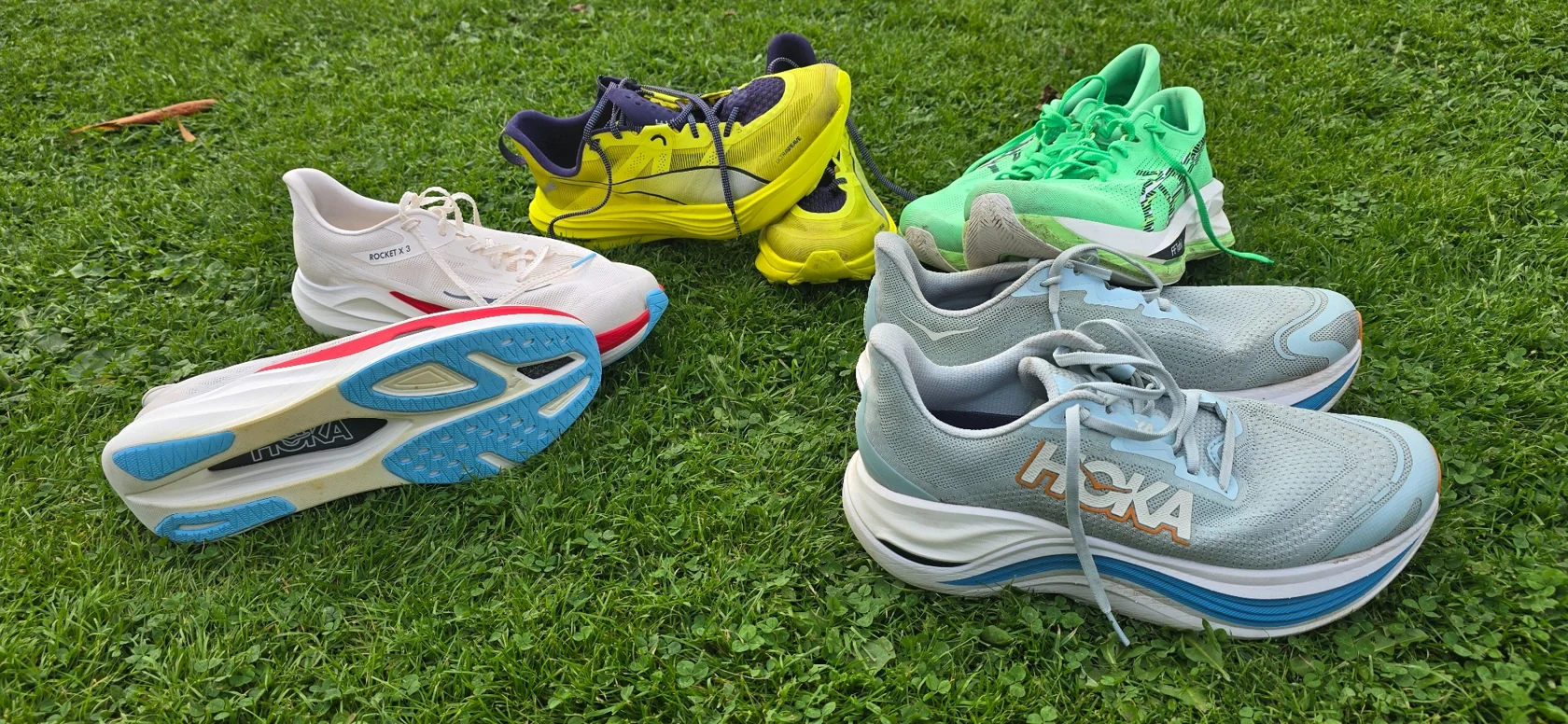
Running shoe rotation
Can several pairs mean fewer injuries and better progress?
One pair for easy runs, one for speed and perhaps one for trails. Rotating shoes can be useful, but the benefits depend on what each pair actually adds. Research offers some good arguments for variety — and several reasons to stay realistic.
A promising finding with an important limitation
One study followed 264 recreational runners for 22 weeks. Using several pairs was associated with a lower injury risk in the analysis. However, runners were not randomly assigned to one or several pairs. Other differences between the groups may have influenced the result. The finding supports rotation as a possible strategy, not a guarantee. [1]
One possible explanation is that different shoes distribute loads differently. In a small study, a particular rocker shoe reduced work at the ankle and increased it at the knee. Load can shift without necessarily becoming lower overall. The study measured movement and forces, not injuries over time. [2]
A shoe can be both soft and stiff
When a runner calls a shoe “soft”, they may mean several things. To understand loading, we need to distinguish the properties.
| Property | What does it describe? |
|---|---|
| Foam softness | How easily the midsole compresses under load. |
| Bending stiffness | How much the shoe resists bending lengthwise, particularly at the forefoot. |
| Rocker | The sole shape that helps the shoe roll through the stride. |
A shoe with soft foam can also have high bending stiffness. Neither “soft” nor “carbon” alone tells us enough about how it loads your body. A laboratory study that varied bending stiffness found changes in joint mechanics, but did not follow the runners to measure injuries. [3]
Cushioning has also been studied using actual injuries as an outcome. In a randomised study of 848 runners, the harder-cushioning group had more injuries than the softer-cushioning group. In subgroup analyses, the difference was statistically clear among lighter runners. An earlier study of 247 runners, with a smaller difference between the soles, found no clear injury difference. This does not establish a rule that the softest shoe is always the safest. [4, 5]
A case series described five navicular bone stress injuries in competitive athletes using carbon-plated shoes. Without a control group, it cannot prove that the shoes caused the injuries or tell us how common they are. It nevertheless gives reason to investigate the relationship and introduce an unfamiliar construction gradually. [6]
Drop: more than the number on the box
Drop is the height difference between heel and forefoot. A higher heel can reduce Achilles tendon loading in some runners, while loading around the kneecap may increase. These are biomechanical findings, not proof of fewer injuries. [12, 13] Different drops may vary loading, but alternating between them has not itself been shown to prevent injuries. A study of 553 runners found no clear difference in overall injury risk between 0, 6 and 10 mm drops. [14]
Advertised and measured drop can also differ: Hoka lists the Skyward X at 5 mm, while RunRepeat measured 9.2 mm in its test sample. [15] This is a measurement without running loads; the foam compresses during a stride. Do not build a rotation around millimetres alone. Introduce unfamiliar shoes gradually, particularly lower drops when your calf or Achilles is sensitive.
Do shoes need rest days of their own?
Foam can change shape and mechanical response under load, then partly recover afterwards. That is different from permanent wear.
In a laboratory test of five EVA shoes, three received roughly 22 hours of rest after each simulated 20 km. After resting, these absorbed more energy than the shoes loaded continuously. This shows that rest can affect the material. It does not show that every shoe needs 48 hours, or that greater energy absorption means greater energy return. [7]
A master’s thesis on the Nike Pegasus Turbo II found no clear benefit from two or three rest days compared with one. One model and a limited experimental setup cannot establish a universal time rule. [8]
| Time until next use | What can we say? |
|---|---|
| Two runs on the same day | Another pair can be practical. Any injury benefit is unknown. |
| About one day | Rest can give the material time to recover. |
| Two to three days | Not established as generally better than one day. |
Permanent material damage does not necessarily disappear with rest either. Different foams tolerate repeated loading differently. Results from one construction cannot be transferred directly to every modern foam. [9]
Two pairs last longer on the calendar when mileage is shared. That does not prove more kilometres per pair: 600 km + 600 km is 1,200 km whether the pairs are used in rotation or one after the other. Several pairs also mean a higher initial cost.
Better sessions are not the same as better fitness
Shoes can affect the energy cost of a run. A controlled study found roughly four per cent lower energy cost in a particular racing shoe than in two comparison shoes. A more recent study of 15 runners found less fatigue after an hour of running in one advanced racing shoe. These are results for particular shoes under particular conditions. [10, 11]
They do not show that ordinary shoe rotation produces greater fitness gains over months. If variety makes it easier to train consistently and choose suitable shoes, it may provide an indirect benefit. That connection remains a reasonable hypothesis.
Let your next pair meet a real need
Start with the shoe that works
A comfortable all-round shoe can cover a lot. Your number of pairs does not measure how well you train.
Add a clear function
Trail grip, a different fit or a shoe for faster sessions can be good reasons. Two identical pairs allow drying time but offer little deliberate construction variety.
Watch your own response
Note which shoe you used and how your feet and calves feel during and after the run. Look for repeated patterns.
Let your training guide you
If you run three times a week with days in between, your shoes already get breaks. Double sessions and wet runs create a more practical need for several pairs.
Use Watshoo Finder to compare shoes for your next session. A match score describes suitability within the model, not medical protection against injury.
The research behind the article
Numbers refer to the sources cited in the text. Practical advice reflects editorial judgement, not research-defined thresholds.
- Malisoux et al. (2015). Can parallel use of different running shoes decrease running-related injury risk?
Adjusted hazard ratio 0.614; 95% confidence interval 0.389–0.969.
- Sobhani et al. (2017). Biomechanics of running with rocker shoes.
- Yang et al. (2025). Effects of varying longitudinal bending stiffness in running shoes on lower limb biomechanics of elite marathon runners.
- Malisoux et al. (2020). Shoe Cushioning Influences the Running Injury Risk According to Body Mass.
Randomised study, 848 runners.
- Theisen et al. (2014). Influence of midsole hardness of standard cushioned shoes on running-related injury risk.
- Tenforde et al. (2023). Bone Stress Injuries in Runners Using Carbon Fiber Plate Footwear.
Case series in a clinical commentary.
- Allen et al. (2020). Effect of Rest Periods on Mechanical Ageing of Running Shoes.
Conference paper.
- Hagen (2021). Recovery Effects on the Performance of Athletic Shoes.
Master’s thesis.
- Aimar et al. (2024). Compression fatigue of elastomeric foams used in midsoles of running shoes.
- Hoogkamer et al. (2018). A Comparison of the Energetic Cost of Running in Marathon Racing Shoes.
The manufacturer was involved in the study.
- Steele et al. (2025/2026). Advanced Footwear Technology Slows Oxygen Uptake Drift and Reduces Neuromuscular Fatigue During Extended Running.
- Farris et al. (2012). The effects of orthotic heel lifts on Achilles tendon force and strain during running.
Small trial with 10 women and 12/18 mm heel lifts; not a direct comparison of regular shoe models.
- Zhang et al. (2022). The effect of heel-to-toe drop of running shoes on patellofemoral joint stress during running.
Laboratory study with 18 runners; modelled patellofemoral loading, not injuries over time.
- Malisoux et al. (2016). Influence of the Heel-to-Toe Drop of Standard Cushioned Running Shoes on Injury Risk in Leisure-Time Runners.
Randomised study with 553 runners over six months. Tested fixed drops, not rotation between drops.
- RunRepeat. HOKA Skyward X: advertised and laboratory-measured drop.
RunRepeat's measurement of a test sample, compared with the manufacturer's advertised drop. Not an injury study.
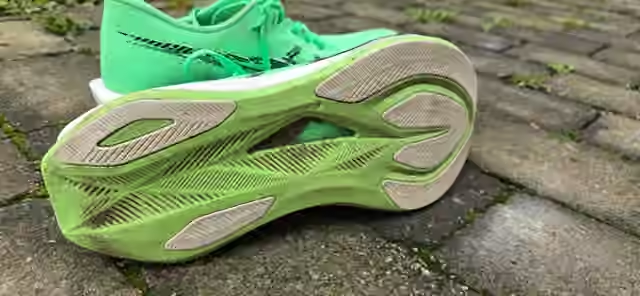
Photos: Magnus Akselsen / Watshoo. The main photo shows part of Magnus’s shoe rotation. The detail photo comes from Watshoo’s Sonicblast review. The photos illustrate the article; the pictured models are not necessarily the shoes used in the studies.